

Manage risk and ambition in an uncertain future
Application of scenario planning for:

Risk management
Risk management
Effective risk management starts with identifying potential threats before they become critical issues. Through a structured approach, scenario analysis helps you identify risks that might otherwise go unnoticed — from climate impacts to regulatory changes and market disruptions.
Once risks are identified, the next step is crafting tailored responses. Whether it’s mitigating, transferring, or accepting risks, scenario planning allows you to explore various strategies to manage uncertainty. By anticipating challenges and formulating clear, actionable responses, clear foresight ensures that your risk management approach is proactive and that your business remains resilient in an uncertain future.

Strategy
Strategy
In today’s uncertain world, businesses need more than a static plan—they need strategies that can adapt and thrive under a range of possible futures. Scenario analysis, or scenario planning, enables you to test the resilience of your strategy by exploring how different climate, market, or regulatory scenarios could impact your business.
Rather than waiting for change to happen, scenario planning helps you anticipate risks and uncover opportunities. It empowers you to develop strategies that are not only robust in the face of uncertainty but also adaptable as conditions evolve. With clear foresight’s structured approach, you can confidently craft strategies that are prepared for whatever the future holds.

Reporting
Reporting
Climate-related scenario analysis has become a crucial element of corporate disclosure, first introduced by the TCFD in 2017. What began as voluntary guidelines has evolved into mandatory requirements in many jurisdictions, now embedded within frameworks such as the CSRD and ISSB.
Navigating the maze of disclosure frameworks — whether CSRD, ISSB, TCFD, TNFD, or CDP — can be complex. That’s where clear foresight steps in. With our proven scenario analysis method, you’ll not only meet compliance standards but also gain valuable insights into how different scenarios impact your business. This allows you to turn regulatory challenges into strategic opportunities.
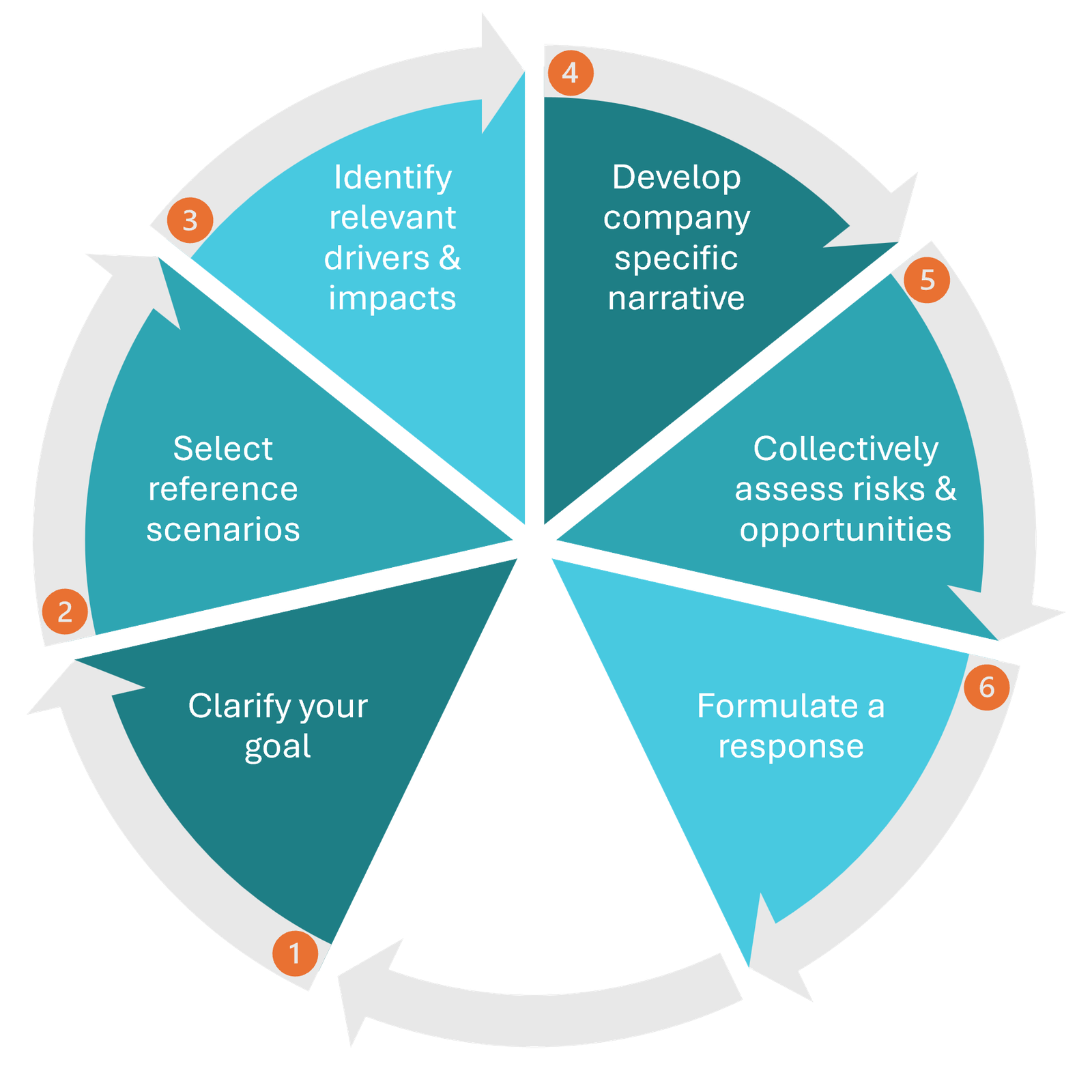
The Climate Resilience Cycle
A 6-step approach for structured scenario analysis
Original publication by Huiskamp, ten Brinke & Kramer (2022)
Success Factors
During my research on and application of scenario analysis at a range of different companies, I have been able to identify 4 key success factors:
Insights

From Climate Risk to Strategic Insight
